Every tradition old enough to matter eventually accumulates a mythology around it — claims repeated so often, by so many people, that nobody thinks to ask where they actually came from. Sauna has one of the thicker mythologies in modern wellness, precisely because it’s old enough to be genuinely true in places and young enough, as an American trend, to have picked up a great deal of nonsense along the way. Somewhere in Finland, a person born into this tradition finds most of what follows faintly absurd — not because the questions are unwelcome, but because the answers were never actually mysterious. They were just never written down for anyone outside the sauna to read.
What follows is the version we’d want someone to have, if they only ever read one thing we published. Eight claims. One honest verdict each, backed by what the evidence actually says — not what sounds good on a supplement label.
Myth 1: “Sauna Makes You Live Longer”
Verdict: Depends, leaning true — and the lean is stronger than most claims in wellness ever get.
The Kuopio cohort remains the backbone of this claim for good reason: over 2,000 Finnish men, tracked for two decades, with those saunaing four to seven times weekly showing significantly lower cardiovascular and all-cause mortality than once-a-week users. That’s not a small effect size buried in a single underpowered study. It’s one of the more consistently cited findings in the entire body of sauna research.
Here’s where culture and science diverge slightly. A Finn wouldn’t describe this as chasing longevity — sauna was never adopted as a life-extension strategy, the way it’s often marketed to an American audience hunting for biohacks. It was simply Tuesday. The health data arrived centuries after the habit did, which is itself worth sitting with: sometimes the culture gets the practice right long before the science can explain why.
The honest caveat, stated plainly: this is observational data. Men who sauna four to seven times weekly likely share other protective habits — diet, activity level, social connection — and teasing apart sauna’s isolated contribution from that entire pattern of living well is genuinely difficult. But here’s what keeps researchers confident rather than dismissive: when the other likely contributors are estimated and accounted for, indirect modeling still points to a large, independent sauna effect underneath the noise. The association was never a promise. It’s a strong, repeatedly confirmed correlation, with the underlying causal signal considered close to settled by the people who study it for a living.
Myth 2: “Sauna Is Dangerous for Your Heart”
Verdict: Myth, for nearly everyone — and the actual risk factor might surprise you.
For healthy individuals, sauna use is associated with measurably lower cardiovascular risk — the precise opposite of what this myth claims. That’s not a marginal finding; it shows up across the same large cohort studies underlying nearly everything else in this series.
The nuance worth respecting: real contraindications exist. Unstable angina, a recent heart attack, severe aortic stenosis, decompensated heart failure, and uncontrolled hypertension are legitimate, medically recognized reasons to check with a physician first. A tradition doesn’t earn respect by pretending it’s risk-free for everyone. It earns respect by being honest about the narrow cases where caution genuinely matters.
Here’s the detail most fear-based headlines leave out entirely: in the Finnish research examining sauna-related cardiac events, alcohol was a significant contributing factor in a meaningful share of cases — not the heat itself. Somewhere, a culture that treats sauna as ordinary infrastructure also treats mixing it heavily with drinking as obviously unwise, without needing a headline to tell them so.
Strip the alcohol variable out, and the heart-safety picture is almost boringly reassuring: for the healthy majority, this is one of the more consistently protective habits in the entire body of cardiovascular research, not a hidden risk waiting to surface. Genuinely risky for a narrow few with real contraindications. Genuinely safe, and genuinely good for the heart, for nearly everyone else.
Myth 3: “Sauna Sweats Out Microplastics and Heavy Metals”
Verdict: Mostly myth, wearing a small grain of truth as a disguise.
This one deserves more room than the others, because the honest answer splits cleanly into two very different claims wearing the same sentence.
Microplastic particles themselves do not exit the body through sweat. They’re structurally too large and complex to pass through sweat glands — current research offers no meaningful support for that specific pathway. Full stop. This half of the myth is simply false, dressed up in scientific-sounding language to seem otherwise.
Trace chemicals and certain heavy metals are a different, genuinely real story. They have been measured in sweat, in some cases at concentrations exceeding blood levels. That detail is accurate, and it’s exactly what keeps this myth breathing.
Here’s the culture-versus-science tension worth naming directly: the word “detox” is a modern marketing invention, retrofitted onto an old, unrelated practice. Nobody in the sauna’s original tradition ever used that language, because the sauna was never sold as a cleansing device — it was simply heat, community, and ritual. The word arrived later, imported from wellness marketing that needed a mechanism to sell.
The scale settles the argument without needing a precise percentage. Kidneys filter roughly 180 liters of blood plasma every single day — continuously, automatically, asking nothing of anyone. A genuinely intense sauna session might produce somewhere around a liter of sweat. One system processes an enormous, unglamorous volume as its full-time occupation. The other is a helpful footnote, doing what it modestly can. Sweating isn’t nothing. It’s also nowhere near what the word “detox” was built to imply — and the tradition never claimed otherwise. Modern marketing did.
Myth 4: “Sauna Cures Colds, Flu, and Hangovers”
Verdict: Myth as a cure. Genuinely true as prevention — a more useful claim than the one people actually repeat.
The same 1990 clinical trial cited to support this claim quietly proves the opposite of what people take from it. Once participants in that study actually got sick, their colds lasted exactly as long and hit exactly as hard as everyone else’s. Sauna didn’t touch the illness once it had already arrived.
What the same trial did find, and what almost never makes it into the retelling: regular users caught roughly half as many colds over the following months, with the protective effect strengthening after about three months of consistent use. That’s not folklore. That’s a genuine, if modest, prevention effect — just not the emergency cure people want it to be.
The hangover version of this claim deserves its own honest warning, separate from the cold and flu discussion. A hangover is, in large part, a dehydration problem — and heat exposure pushes fluid loss further, not less. Reaching for sauna to fix a hangover isn’t a mild misunderstanding. It’s stacking a real risk directly on top of an existing one, at exactly the moment the body can least afford it.
There’s a quieter cultural point buried here too. A society that treats sauna as a weekly habit isn’t reaching for it in a moment of crisis, the way a rough-looking tourist might search “sauna hangover cure” the morning of a flight home. It’s simply part of the routine, contributing slowly to a baseline of resilience most people never notice building. Prevention rarely feels dramatic while it’s happening. That’s exactly why it gets overlooked in favor of the more exciting, less true version of the claim.
Myth 5: “Hotter, Longer, More Intense Is Always Better”
Verdict: Myth — and one of the more consistently disproven claims in the entire body of heat research.
The evidence points to a specific, well-defined range — roughly 70–90°C (158–194°F) — where the documented cardiovascular and cellular benefits actually occur. Push meaningfully past it chasing a more extreme experience, and the research shows diminishing returns paired with genuinely rising risk: dehydration, burns, heat exhaustion.
There’s a certain dry humor in how differently cultures approach this. Somewhere, endurance in the sauna gets treated as a badge of honor worth posting about — the hottest setting, the longest hold, bragging rights measured in minutes survived. In the tradition this practice actually descends from, that instinct barely registers. Nobody needs to prove anything to a room they’ve been sitting in their whole life. The performance is for tourists. The habit was never about performance to begin with.
The body doesn’t reward the extreme version of this practice. It was never about intensity to begin with. It rewards consistency — the same well-calibrated session, returned to again and again, with nothing left to prove each time.
Myth 6: “Sauna Makes You Lose Weight”
Verdict: Myth — genuinely close to true in one narrow sense, and that’s exactly what makes it dangerous.
A 2019 study found real, measurable calorie expenditure from sauna use — roughly 330 calories over 40 minutes, comparable to a brisk walk. That’s not nothing, and it’s the kernel of truth this myth survives on.
But the weight that vanishes from the scale immediately afterward is water, not fat, and it returns the moment you rehydrate. Weight loss remains governed by the same unglamorous equation it has always been governed by: calories in versus calories out. That equation is true. It’s also incomplete on its own — it doesn’t explain why one person eats more than they burn while another doesn’t, and the honest reasons behind that gap are usually hormonal, behavioral, and deeply individual, not a simple failure of willpower. No tradition, no ritual, no amount of heat has ever quietly repealed the math. It also was never going to solve the harder, more human question sitting underneath it.
Sauna can be one part of a life built around genuine health — the same way it always has been for the culture that built the ritual in the first place. It was never sold as a diet hack there. It doesn’t need to become one here.
Myth 7: “Cold Plunge Is Optional — Feel Free to Skip It”
Verdict: Myth, and worth saying directly — skipping the cold half isn’t a neutral choice.
The vascular pump created by alternating heat and cold — vasodilation, then vasoconstriction, repeated — produces a circulatory effect neither temperature achieves working alone. Cold immersion separately triggers a genuine norepinephrine surge, tied to real, measurable improvements in alertness and mood.
Here’s what makes this pairing worth real respect rather than a passing trend: cultures with no shared history, no contact, no common ancestor for the idea, independently arrived at the same pairing. Heat, then cold, repeated. That kind of convergence rarely happens by coincidence. It happens because something in it actually works, discovered again and again by people who never once compared notes.
The plunge was never the bonus round tacked onto the real experience. It’s the second half of one complete idea.
Myth 8: “Infrared Sauna Is Not a Sauna”
Verdict: Mostly true — and this one deserves two separate answers, because it’s actually two separate claims.
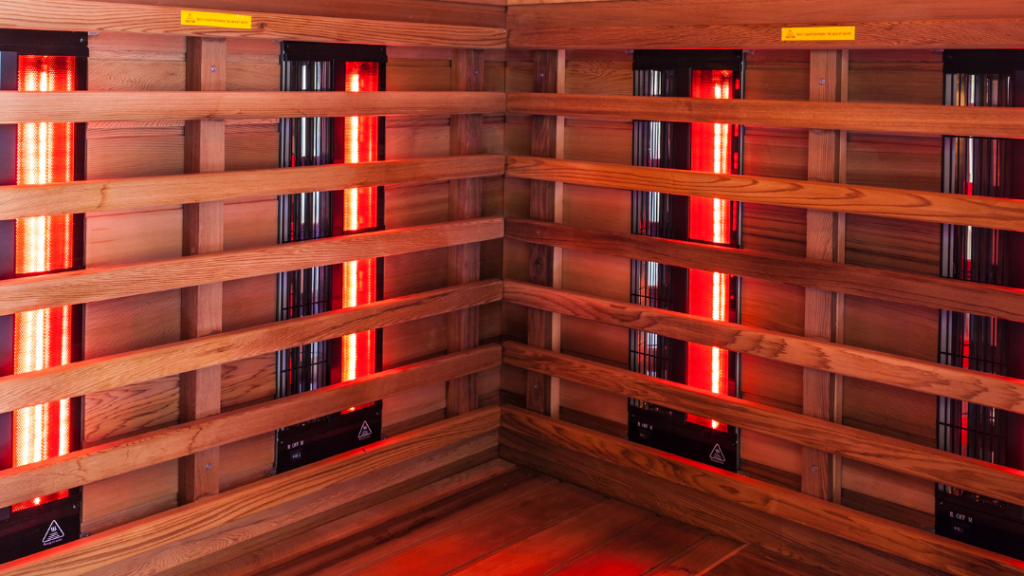
The physiology argument: here, the myth mostly overstates its case. Infrared and traditional sauna trigger a genuinely similar cardiovascular response — elevated heart rate, real sweating, real physiological stress — through a different delivery mechanism, at a gentler intensity. The evidence base behind infrared is real, just newer and thinner than the decades of research built on traditional Finnish sauna. Different method, similar underlying principle, less time in the research literature. On physiology alone, this myth mostly doesn’t hold up.
The cultural argument is where it becomes true. Traditional sauna was never only about the heat itself. It’s wood and stone, water thrown until it rises as steam — löyly, the moment many consider the actual soul of the experience. It’s the cold that follows immediately after, often a lake or snow within arm’s reach. It’s food and a cold drink shared afterward, the specific, deliberate collision of hot skin against a cold glass. It’s an evening stretched across hours, not a twenty-minute session squeezed between two calendar obligations. That entire architecture — the ritual, the hospitality, the people gathered around it — only exists in the traditional room. It cannot be replicated by a panel and a thermostat.
So: an infrared cabin is not a sauna, in the fullest sense of what the word was ever meant to hold. That’s not a knock on infrared, and it’s not aimed at anyone who genuinely loves it. The physiology is real and worth having. It simply isn’t the ritual. Those are two different, both genuinely good things — and confusing one for the other is where this myth actually earns its “mostly true.”
Sources: Laukkanen T, Khan H, Zaccardi F, Laukkanen JA. JAMA Internal Medicine, 2015. Ernst E, et al. Annals of Medicine, 1990. Podstawski R, et al. BioMed Research International, 2019. Kidney glomerular filtration rate data: standard renal physiology references (approximately 180 L/day, GFR ~120-125 mL/min).