
Somewhere in eastern Finland, a cohort of middle-aged men has spent decades unknowingly rewriting what we know about heat and the aging brain. We met them in our first post — the same Kuopio group whose sauna habits were tracked against cardiovascular death. It turns out their data didn’t stop at the heart.
The Study
In 2016, researchers from the University of Eastern Finland went back to that same population — over 2,000 men, tracked for more than two decades — and asked a different question: does sauna frequency predict dementia risk?
The results were striking. Men who used the sauna four to seven times a week had a 66% lower risk of developing any form of dementia, and a 65% lower risk of Alzheimer’s disease specifically, compared with men who saunaed only once a week. The relationship held even after adjusting for blood pressure, cholesterol, alcohol use, smoking, diabetes, and prior heart attacks — the usual suspects that tend to explain away findings like this.
It didn’t fully explain it away here. Something about the heat itself, independent of general health status, tracked with a lower dementia risk.
What Might Be Happening
We introduced hormesis in our first post — the principle that a controlled, recoverable dose of stress trains the body to adapt and strengthen, rather than simply wearing it down. The brain, it turns out, may respond to heat stress the same way.
Two mechanisms are the leading candidates. The first is heat shock proteins — the same cellular repair crew we discussed with cardiovascular health — which don’t stop at the heart. They also assist in clearing misfolded proteins throughout the body, including the kind of protein aggregation implicated in Alzheimer’s pathology. The second is neurotrophic signaling: heat exposure appears to increase circulating levels of compounds like brain-derived neurotrophic factor (BDNF), a protein that supports the growth and survival of neurons, particularly in memory-related regions of the brain.
Neither mechanism is fully proven as the explanation. But both are biologically plausible, both are consistent with the hormesis model, and both point toward the same idea: the brain, like the heart and the muscles, may be a tissue that benefits from being occasionally, deliberately stressed — not shielded from all discomfort indefinitely.
The Honest Caveats
We promised elegant and scientific, not oversold — so here’s where we have to be careful.
This study, like the cardiovascular one, is observational — a strong association, not proof of direct causation. It’s also worth noting plainly that this particular cohort was all men. Later Finnish research on a mixed-sex population found a similar protective trend, which is reassuring, but the evidence base for women specifically is still thinner than we’d like.
Here’s the more encouraging way to read the open question, though: nobody has found a point at which starting is too late. Heat shock proteins and neurotrophic signaling respond to the stimulus in front of them, not to a lifetime average — a first sauna session doesn’t know whether it’s your thousandth or your first. And that’s really the point worth holding onto here: a 65% risk reduction, holding up after adjustment for the usual confounders, in a disease with vanishingly few effective interventions, is not a result to shrug off just because the mechanism isn’t fully settled.
Attention Is Also a Practice
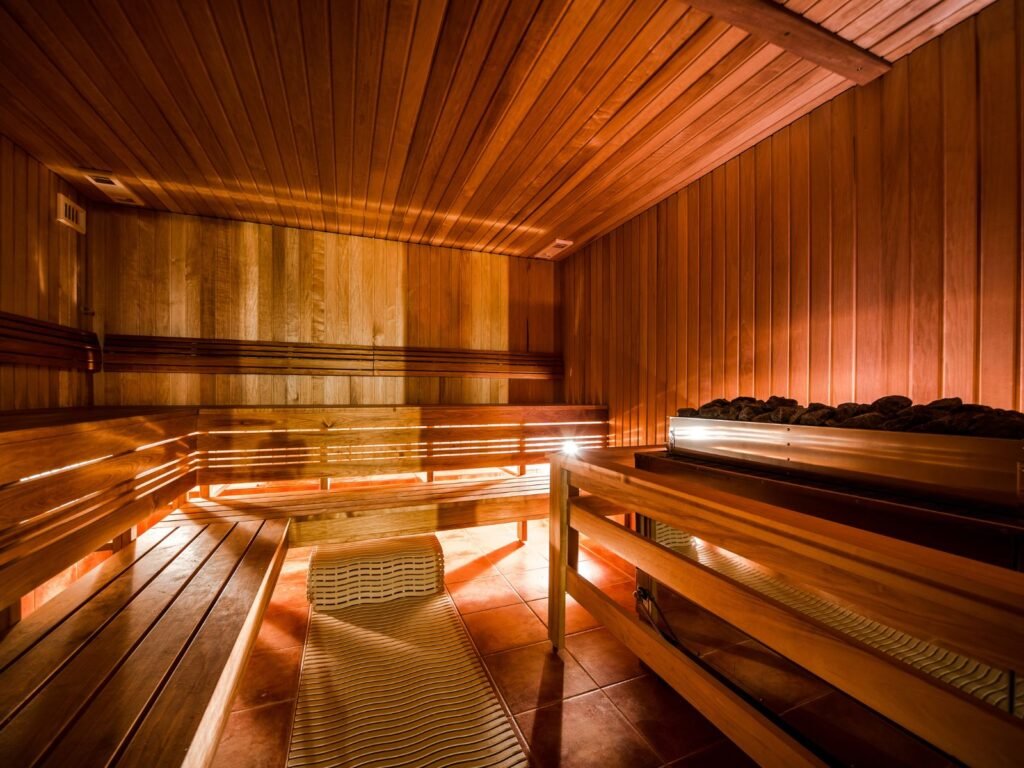
There’s a second, quieter thread worth naming: how you meet the heat may matter as much as the heat itself. Two mechanisms may be working in that room at once — one thermal, adapting tissue and cells to a repeated stimulus, and one attentional, changing how the brain interprets that same stimulus depending on whether it’s met with resistance or with presence. Staying with an uncomfortable sensation, rather than immediately escaping it, appears to change the experience of that sensation — a separate effect from anything happening at the cellular level.
The useful part is that this isn’t sauna-specific. It’s a transferable skill. Twenty minutes practicing composure inside real physical discomfort is, in a sense, rehearsal — for the traffic, the deadline, the difficult conversation. The room is hot on purpose. But it’s also, quietly, practice for everything outside it.
Sources: Laukkanen T, Kunutsor S, Kauhanen J, Laukkanen JA. “Sauna Bathing Is Inversely Associated with Dementia and Alzheimer’s Disease in Middle-Aged Finnish Men.” Age and Ageing, 2017;46(2):245–249.