
What Happens in Thirty Minutes
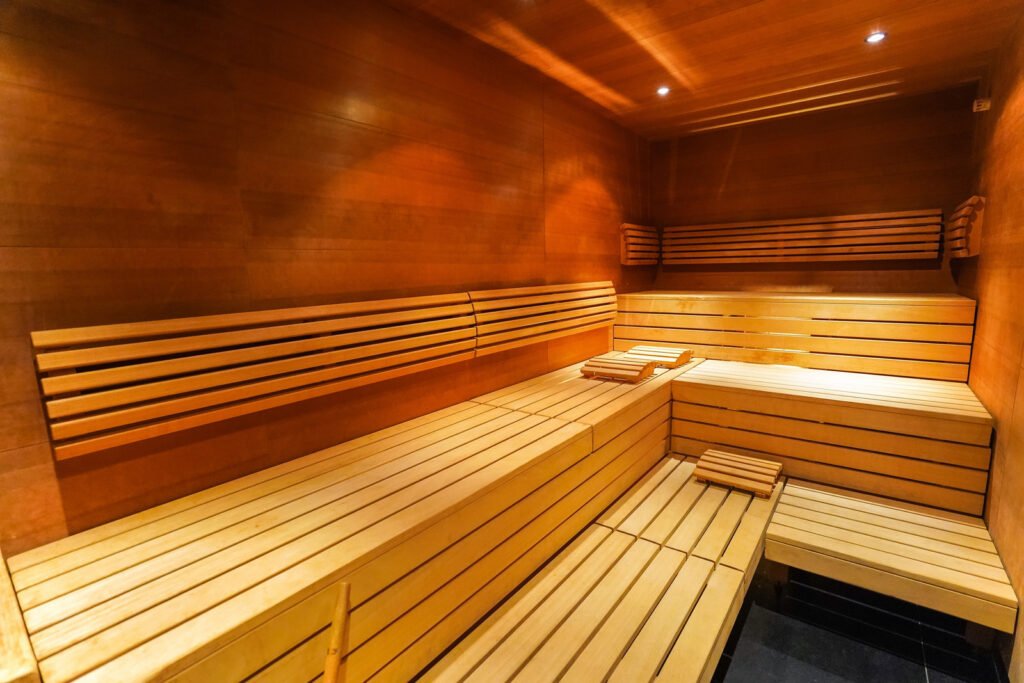
Step into a hot sauna and the cardiovascular system responds the way it would to real physical exertion, because as far as the heart is concerned, that’s exactly what heat is. Heart rate climbs, often into the same range you’d see on a brisk walk. Blood vessels near the skin’s surface widen to help release that heat, which increases blood flow and eases the resistance the heart is pumping against. Sweating begins, shifting fluid balance. And once the body has cooled back down afterward, blood pressure typically settles not just back to normal, but measurably below where it started for a period of time.
None of this is exotic, and none of it is folklore. It’s the same basic signature produced by moderate aerobic exercise — elevated heart rate, vascular dilation, a post-exertion dip in blood pressure — just measurable, repeatable, and increasingly well understood as it applies to heat instead of movement.
The Trial That Moves Past Correlation
Our first post relied on the Kuopio cohort — two decades of observational data linking sauna frequency to lower cardiovascular mortality. Strong data, but observational, which means it can show association without proving cause.
A controlled study puts numbers to the physiology above: in over a hundred adults with at least one cardiovascular risk factor, a single 30-minute sauna session at 73°C produced heart rate rising from roughly 65 to 81 beats per minute, diastolic blood pressure dropping from 82 to 75 mmHg, and arterial stiffness — measured as pulse wave velocity — decreasing measurably. Thirty minutes after leaving the heat, blood pressure was still lower than baseline.
That’s one session. A separate, more recent randomized controlled trial asks what happens after eight weeks of them. Adults with confirmed coronary artery disease were split into two groups: one used a Finnish sauna four times a week for eight weeks, the other made no changes. The sauna group showed measurable improvements in flow-mediated dilation — a direct measure of how well blood vessels widen in response to increased blood flow — along with reduced arterial stiffness. This wasn’t a comparison across different people with different habits and different genetics. It was the same population, randomized, with the sauna as the only deliberate variable.
Flow-mediated dilation might sound like a minor technical detail, but in cardiovascular research, it isn’t. Improvements of just 2% in this measure have been associated with roughly a 15% reduction in cardiovascular risk. The sauna intervention in this trial improved it by over 5%.
The Mechanism
The thread connecting all of this back to hormesis is nitric oxide. Heat exposure increases shear stress on the walls of blood vessels — the physical force of blood moving across the vessel lining — which upregulates an enzyme called endothelial nitric oxide synthase, or eNOS. More eNOS means more nitric oxide, a molecule that signals blood vessels to relax and widen. This is the same core pathway that exercise uses to improve vascular health, and it’s a large part of why the cardiovascular response to sauna resembles the cardiovascular response to moderate exercise so closely.
Layered on top of that: heat shock proteins, introduced in our first post, appear to protect the endothelium — the thin inner lining of blood vessels — from oxidative stress, while repeated heat exposure also seems to favorably shift circulating lipid profiles and improve autonomic nervous system balance, the system governing the constant, automatic negotiation between heart rate, blood pressure, and vascular tone.
None of these mechanisms work in isolation. They appear to reinforce each other, which is likely part of why the cardiovascular data on sauna is some of the most consistent in the entire body of heat-therapy research.
Worth Saying Plainly
Sauna is not a replacement for cardiovascular medicine, and it isn’t risk-free for everyone. People with unstable cardiovascular conditions are given real, specific contraindications for a reason — thermal stress on an already unstable system can cause real harm, not just discomfort. This is a tool with a genuinely strong evidence base, not a universal one. Sensible use means gradual heat exposure, real hydration, and skipping alcohol beforehand — same logic as any legitimate form of physical stress.
Within that window, though, the evidence is layered and consistent: acute measurable effects, mechanistic explanations that make biological sense, and now a randomized trial adding real causal weight to two decades of observational data. That’s not a common combination in wellness research. It’s closer to what a genuinely effective medical intervention looks like — just delivered by a hot room instead of a prescription pad.
Sources: Laukkanen T, Kunutsor SK. “Cardiovascular and Other Health Benefits of Sauna Bathing: A Review of the Evidence.” Mayo Clinic Proceedings, 2018;93(8):1111-1121. Additional data from a randomized controlled trial published in Journal of Applied Physiology, 2023, examining Finnish sauna use in adults with coronary artery disease.